

A Complete Guide to Greek Coffee Culture

guide to Greek coffee

This is your guide to Greek coffee- from how and when Greeks drink it and what each coffee is, to how to order like a local.

Well, coffee here is never just coffee because in Greece, it is not about a quick caffeine hit. It is a pause in the day, a shared moment, an unspoken understanding that time can (and should) slow down.

In fact, you don’t grab a coffee in Greece, you go for coffee. And once you understand that distinction, Greek coffee culture begins to reveal itself.

From elderly men gathering in village squares, to work friends catching up over a Freddo in the afternoon sun, to late-night sips in the city, coffee is an integral part of everyday life- no matter how old you are. Most importantly, it marks time not by the hour, but by connection.

Coffee as a Social Ritual in Greece

From packed city centres to quiet villages and serene islands across Greece, the day often centres around the platía (the main square), where cafés fill gradually from morning until late evening. In big cities like Athens and Thessaloniki, neighbourhoods such as chic Kolonaki and cool urban hubs like Exarcheia and Psyrri are defined as much by their cafés as their streets, with people meeting not once, but several times a day.

Morning coffee.
Afternoon coffee.
Evening coffee.

A single cup may last hours. And just so you know, it arrives with water, remains through conversation, and is still sipped long after it has gone cold. There is no pressure to leave, no expectation to rush.

Traditional Greek Coffee (Ellinikós Kafés)

This is how and where everything started- the foundation of Greek coffee culture.

Traditional Greek coffee is made with finely ground coffee, gently simmered in a bríki and served unfiltered in a small cup. A creamy layer of foam (kaimáki) rests on top, while the grounds settle naturally at the bottom.

Note: It is never stirred, and the final sip is never drunk.

The flavour

Strong and earthy, yet smooth when prepared correctly.

When it’s drunk

It is almost always accompanied by a glass of cold water and a piece of loukoumi.

How to order

Sweetness is decided before the coffee is made.

-Skéto: no sugar

-Métrio: medium sweetness

-Glykó: sweet

For example:

“Énan ellinikó, métrio parakaló.”
“A Greek coffee, medium sweet please.”

Freddo Espresso

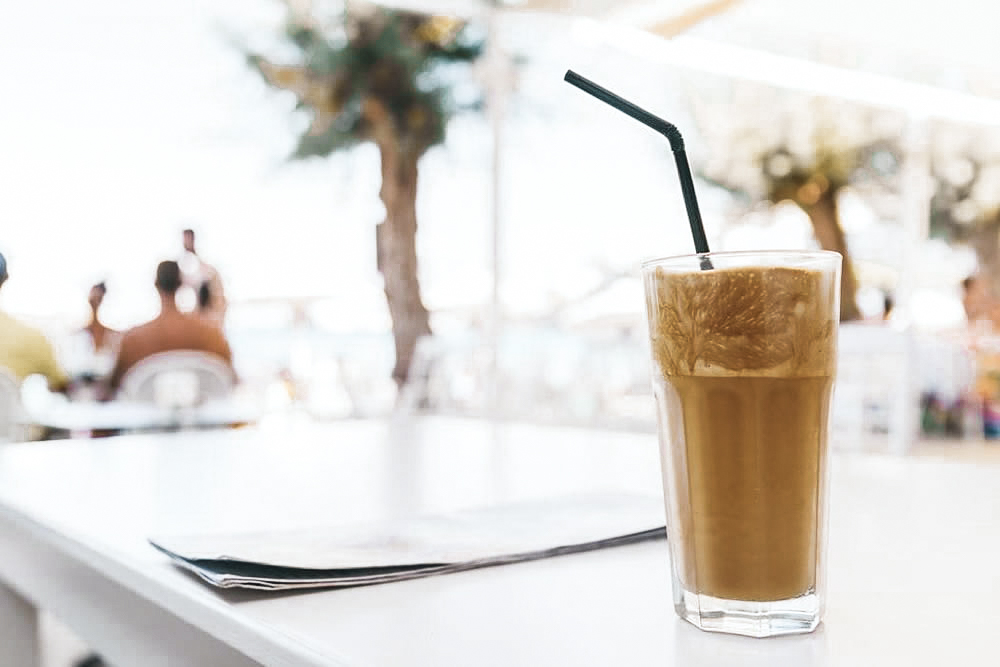
If Greek coffee speaks to tradition, Freddo Espresso is a true reflection of contemporary Greece. It is the most popular iced coffee among Greeks, and you can easily order it almost everywhere.

Prepared with a double shot of espresso shaken over ice until lightly foamy, it is served cold, clean, and refreshingly intense.

The flavour

Bold and smooth, without bitterness.

When it’s drunk

-Early morning 

-Throughout the afternoon 

-Often as a takeaway drink 

In summer, it is everywhere- carried through streets, placed on café tables, slowly sipped under the sun.

How to order

“Freddo espresso, skéto.”

Freddo Cappuccino

Perhaps the most loved coffee in Greece today.

Essentially, it is a Freddo Espresso topped with a thick layer of cold, velvety milk foam, and it is designed not to be rushed but enjoyed slowly.

The flavour

Balanced and creamy, indulgent without heaviness.

When it’s drunk

-Late morning 

-Afternoon social gatherings

-During long cafe conversations 

It is as much about the moment as the coffee itself.

How to order

“Freddo cappuccino, métrio.”

The Greek Frappé

Invented in Greece in the 1950s, the Frappé became synonymous with Greek summer.

Made from instant coffee, water, sugar, and ice, shaken into a thick foam, it is both nostalgic and unmistakably Greek. Although similar in taste to a Freddo, it is less popular today, especially among younger generations who favour their Freddo.

The flavour

Frothy, slightly bitter, and refreshing.

When it’s drunk

-Hot summer afternoons 

-At beach cafes 

-Casual settings and made at home 

How to order

“Frappé, glykó.”

Note: Milk can be added if requested. 

A Final Note on Greek Coffee Time

In Greece, a coffee does not need to be rushed- you can simply order a cup and quite literally spend your entire afternoon enjoying it with friends.

It is an invitation to sit, to speak, to listen, to remain.

No one will hurry you and no one expects you to leave.

Your coffee grants you permission to stay exactly where you are, and that, perhaps, is the most Greek thing of all.

Main image by Bespoke Athens 

It’s Vintage But Still Religiously Slurped: Why is Frappe So Adored?

Greek Frappe is famous worldwide. But what is this coffee which Greeks drink with so much pleasure?

By Maria Athanasopoulou

It’s a cold instant coffee with foam on top and you will find it on the menu of every cafe throughout the country. Invented by accident in 1957, it was created by Dimitris Vakondios from Thessaloniki.
Insights Greece - It's Vintage But Still Religiously Slurped: Why is Frappe So Adored?Its great success is due to its addictive flavour- plus the fact that it can easily be prepared in your own kitchen- which has made it a hit in Greek households.

A simple shaker is the only utensil required to make a Frappe. Sugar, coffee (Greece’s Nescafe), and a quarter of a glass of water are poured into a shaker, and after shaking it well you add several ice cubes, more water and some milk (optional). Your Greek Frappe is ready. Remember to always serve it in a tall glass.

Today, a Freddo Cappuccino is also very popular (the younger generation by far prefer this style) but the Greek frappe is still the most well-known cold coffee not only in Greece but amongst Hellenes abroad who can order it in Greek-owned cafes anywhere in the world and are also able to make it at home. In recent years it has been introduced in other countries too, mostly by those who have spent time in Greece during summer, had a taste of the Greek Frappe, loved it, and took the concept back home.

One of the most “classic” scenes defining a relaxing getaway in Greece over the warmer months, is catching large groups of people at seaside cafes, enjoying the sun, sea, and sand, with a tall glass of Frappe in hand. This beverage really has become synonymous with beach culture and warm weather. If you have already tried it, regardless of whether you love it or not, you have most likely been fascinated by its unique taste- as it truly is an original cold coffee concept. If you have not tried it yet, then I recommend you do so, and discover what this popular type of Greek coffee is all about!

Maria Athanasopoulou is the founder of the tourism marketing company Respond On-Demand, co-founder of the non-profit company Top Tourism, Chairwoman of the World Food Travel Association, Ambassador in Greece of Evintra and Ambassador in Greece and Cyprus of World Gourmet Society. She likes exploring new places and cultures and loves discovering unexplored tourism destinations. During her trips, she does her best to find out and present the most interesting aspects of the destination she has just visited.